

Wie Heißt Die Hauptstadt Von Mecklenburg Vorpommern
| Mecklenburg-Vorpommern Mäkelborg-Vörpommern (Low German language) | |
|---|---|
| State | |
| | |
 | |
| Country | Germany |
| Capital | Schwerin 53°37′N 12°42′Eastward / 53.617°Due north 12.700°E / 53.617; 12.700 Coordinates: 53°37′North 12°42′E / 53.617°North 12.700°East / 53.617; 12.700 |
| Largest city | Rostock |
| Government | |
| • Governing parties | SPD / Left |
| • Bundesrat votes | 3 (of 69) |
| • Bundestag seats | 16 (of 736) |
| • Government minister-President | Manuela Schwesig (SPD) |
| Legislature | Landtag of Mecklenburg-Vorpommern |
| Population | |
| • 2019 guess | ane,609,675[ane] |
| • Density | 69.46/kmtwo (179.9/sq mi) |
| Fourth dimension zone | UTC+one (CET) |
| • Summertime (DST) | UTC+2 (CEST) |
| ISO 3166 lawmaking | DE-MV |
| GRP (nominal) | €47 billion (2019)[2] |
| GRP per capita | €29,000 (2019) |
| Vehicle Registration | Formerly: MP (1945–1947), SM (1948–1953)[3] |
| Nuts Region | DE8 |
| HDI (2018) | 0.921[4] very high · 15th of 16 |
| Website | Mecklenburg-Vorpommern.european union |


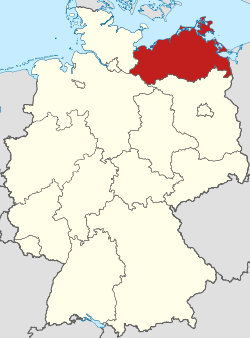
Mecklenburg-Vorpommern (MV; German language: [ˌmeːklənbʊʁkˈfoːɐ̯pɔmɐn] or [ˌmɛk-] (  listen );[5] [6] Low German: Mäkelborg-Vörpommern), too known by its anglicized proper name Mecklenburg–Western Pomerania, is a state in the north-east of Germany. Of the country's sixteen states, Mecklenburg-Vorpommern ranks 14th in population; it covers an expanse of 23,179 km2 (eight,949 sq mi), making it the sixth largest German state in expanse; and it is 16th in population density. Schwerin is the state capital and Rostock is the largest city. Other major cities include Neubrandenburg, Stralsund, Greifswald, Wismar, and Güstrow. It was named later the 2 regions of Mecklenburg and Vorpommern (which means West Pomerania).
The land was established in 1945 subsequently Earth War 2 through the merger of the historic regions of Mecklenburg and the Prussian Western Pomerania by the Soviet military administration in Allied-occupied Germany. Information technology became function of the German Democratic Commonwealth in 1949, merely was dissolved in 1952 during administrative reforms and its territory divided into the districts of Rostock, Schwerin, and Neubrandenburg. A country chosen in German Mecklenburg-Vorpommern was re-established in 1990 following German reunification and became one of the new states of the Frg.
On the state's coastline on the Baltic Sea are many holiday resorts and much unspoilt nature, including the islands of Rügen, Usedom, and others, as well as the Mecklenburg Lake District, making the country one of Germany'south leading tourist destinations. Three of Germany'southward fourteen national parks, also equally several hundred nature conservation areas, are in the state. The University of Rostock, founded in 1419, and the Academy of Greifswald, established in 1456, are among the oldest universities in Europe. In 2007, the 33rd G8 summit took place at the Grand Hotel Heiligendamm on the Mecklenburg Baltic coast during the chancellorship of Angela Merkel, a native of Mecklenburg-Vorpommern.
Proper noun [edit]
Due to its lengthy name, the state is often abbreviated as MV or (colloquially) shortened to MeckPomm.[seven] In English language, it is unremarkably named as "Mecklenburg-Western Pomerania". Inhabitants are called either Mecklenburger or Pomeranians, the combined form is never used.
The full name in German is pronounced [ˈmeːklənbʊʁk ˈfoːɐ̯pɔmɐn]. Sometimes, Mecklenburg is pronounced [ˈmɛklənbʊʁk], because the digraph ⟨ck⟩ marks a preceding brusque vowel in High german. Nevertheless, Mecklenburg is within the historical Depression German language language surface area, and the ⟨c⟩ appeared in its name during the period of transition to Standard, High High german usage (Low German authors wrote the proper name Meklenborg or Męklenborg, depicting proper Low German pronunciation, which itself was a syncope of Heart Low German Mekelenborg). The introduction of the ⟨c⟩ is explained equally follows: Either the ⟨c⟩ signals the stretched pronunciation of the preceding ⟨due east⟩ (Dehnungs-c), or it signals the pronunciation of the subsequent ⟨k⟩ as an occlusive [k] to prevent it from falsely being rendered as a fricative [χ] following a Depression High german trend.[eight] Another explanation is that the ⟨c⟩ comes from a mannerism in Loftier German language officialese of writing unnecessary letters, a and then-called Letternhäufelung (lit. 'letter accumulation', equally was done sometimes in English with words such as "doubtfulness"). The identify name Vorpommern, at its base derives from West Slavic languages, with the prefix "po-" meaning along or at, and the base word "more" meaning ocean — together "po more" means Land at the Sea — while the German prefix "vor-" denoted a closer location, and is the equivalent of the discussion "hither" in English.[nine]
History [edit]

In the aftermath of the Second Earth War and German reunification in 1990, the state was constituted from the celebrated region of Mecklenburg and Western Pomerania, both of which had long and rich independent histories.[10]
Prehistory [edit]
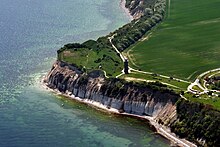
Human settlement in the area of mod Mecklenburg and Vorpommern began afterwards the Ice Historic period, about ten,000 BC. Near two thousand years agone, Germanic peoples were recorded in the area. Nigh of them left during the Migration Period, heading towards Spain, Italian republic, and France, leaving the surface area relatively deserted. In the sixth century Polabian Slavs populated the expanse. While Mecklenburg was settled past the Obotrites, Pomerania was settled past the Veleti (subsequently Liuticians) and the Rani.[xi]
Along the coast, Vikings and Slavs established trade posts like Reric, Ralswiek and Menzlin. In the 12th century, Mecklenburg and Vorpommern were conquered by Henry the King of beasts and incorporated into the Duchy of Saxony, joining the Holy Roman Empire in the 1180s. Parts of Mecklenburg and Pomerania were settled with Germans in the Ostsiedlung process, starting in the 12th century.[11]
Mecklenburg [edit]
In the belatedly twelfth century, Henry the Lion, Duke of the Saxons, conquered the Obotrites, subjugated its Nikloting dynasty, and Christianized its people. In the course of time, High german monks, nobility, peasants and traders arrived to settle here. Afterwards the twelfth century, the territory remained stable and relatively contained of its neighbours; one of the few German territories for which this is true. Mecklenburg outset became a duchy of the Holy Roman Empire in 1348. Though later partitioned and re-partitioned inside the same dynasty, Mecklenburg always shared a common history and identity. The states of Mecklenburg-Schwerin and Mecklenburg-Strelitz became Grand Duchies in 1815, and in 1870 they voluntarily joined the new German language Empire, while retaining their own internal autonomy. Later the First World War and the abdication of the High german Kaiser, the monarchies of the duchies were abolished and republican governments of both Mecklenburg states were established, until the Nazi government merged the two states into a unified state of Mecklenburg, a virtually meaningless administrative decision under the centralised government.
Western Pomerania [edit]


Flag of the State of Mecklenburg-Western Pomerania
Vorpommern, literally Fore-Pomerania, is the smaller, western function of the former Prussian Province of Pomerania; the eastern office became part of Poland later on the stop of World War II.
In the Center Ages, the area was ruled by the Pomeranian dukes as part of the Duchy of Pomerania. Pomerania was under Swedish rule after the Peace of Westphalia from 1648 until 1815 as Swedish Pomerania. Pomerania became a province of Prussia in 1815 and remained so until 1945.
Mecklenburg-Vorpommern [edit]
Wartime [edit]
In May 1945, the armies of the Soviet Spousal relationship and the Western allies met e of Schwerin. Following the Potsdam Agreement, the Western allies handed over Mecklenburg to the Soviets. Mecklenburg-West Pomerania was established on 9 July 1945, past order No. 5 of Red Army Marshal Georgy Zhukov, head of the Soviet Military Administration in Germany (SMAD), as the Province of Mecklenburg and West Pomerania (zapadnoi Pomeranii).[12]

During the war, the make-up of Mecklenburg and Vorpommern's population changed, due to wartime losses and the influx of evacuees (mainly from the Berlin and Hamburg metropolitan areas that were subject to air raids). After the war, people who fled and were expelled from the onetime eastern territories of Federal republic of germany east of the Oder-Neisse line settled in Mecklenburg-Vorpommern (and elsewhere in Frg), increasing the population past xl%. Before the war, Mecklenburg and Western Pomerania had a population of 1,278,700, of whom many perished during the state of war and others moved west in the course of the Red Army'due south advance. In 1947, some 1,426,000 refugees from the former eastern parts of Germany were counted. Nigh of them settled in rural communities, simply the urban population as well increased, nearly notably in Schwerin from 65,000 (1939) to 99,518 (January 1947), in Wismar from 29,463 to 44,173, and in Greifswald from 29,488 to 43,897.[13] Western Pomerania was additionally stripped of the area effectually the Pomeranian regional capital Stettin/Szczecin also as the city itself, despite its location to the w of the river Oder.
High german Democratic Republic [edit]
On 5 June 1946, a constabulary enacted past the Soviets constituted a provisional German administration (Beratende Versammlung, English language: "Consulting assembly") under Soviet supervision on 29 June 1946. After elections on 20 October 1946, a Landtag replaced the Beratende Versammlung and created the constitution of 16 Jan 1947, for the Land Mecklenburg-Vorpommern. On xviii Apr 1947, the state'south name was shortened to State Mecklenburg. Mecklenburg became a elective country ("State") of the German Democratic Republic (GDR) upon its formation in 1949. In 1952, the East German language government abandoned the term Land in this context and redesignated its administrative territorial divisions every bit "districts" (German: Bezirke). The territory of Mecklenburg and Vorpommern was divided into iii districts that covered roughly the aforementioned area: Bezirk Rostock, Bezirk Schwerin and Bezirk Neubrandenburg. These were commonly known equally the Nordbezirke (northern districts) under the highly centralised GDR government. The Eastward German language government developed the shipyards in the sometime Hanseatic ports (the largest being in Rostock and Stralsund), and as well established the Greifswald Nuclear Power Plant in Lubmin nigh Greifswald.
Reunification [edit]
At the time of German reunification in 1990, the eastern states were reconstituted along their postwar boundaries (with minor adjustments) as they had existed until 1952, and the historic name Mecklenburg-Vorpommern was restored. Since 1990, the land has undergone dramatic changes. What had been largely an industrial and agricultural economic system is increasingly driven by the service, tourism, and high-tech sectors. The old towns, hundreds of castles and manors, resort buildings, windmills, churches, and various other cultural monuments of Mecklenburg-Vorpommern have been renovated in recent years. Since 2013, net migration into the state has been positive over again.
Geography [edit]
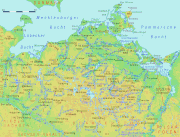
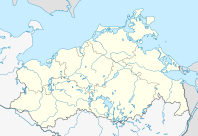
Map of Mecklenburg-Vorpommern, showing locations, heights, and waters
Location and urban areas [edit]
Sixth-largest in expanse and fourteenth in overall population amid Germany'southward xvi Bundesländer (federal states), Mecklenburg-Vorpommern is bounded to the north past the Baltic Sea, to the westward by Schleswig-Holstein, to the southwest by Lower Saxony, to the s by Brandenburg, and to the east by the West Pomeranian Voivodeship in Poland.
Mecklenburg-Vorpommern'southward land capital is Schwerin. The largest metropolis is Rostock with approximately 205,000 people, followed by Schwerin. Other major cities include Neubrandenburg, Stralsund, Greifswald, Wismar and Güstrow.
Districts [edit]

Schwerin, the state majuscule of Mecklenburg-Vorpommern

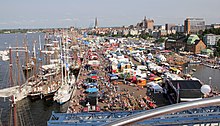
Rostock, the largest urban center in Mecklenburg-Vorpommern
Since 4 September 2011, Mecklenburg-Vorpommern is divided into 6 Kreise (districts):
- Landkreis Rostock
- Ludwigslust-Parchim
- Mecklenburgische Seenplatte
- Nordwestmecklenburg
- Vorpommern-Greifswald
- Vorpommern-Rügen
Also counting two independent urban districts:
- Rostock (HRO)
- Schwerin (SN)
Landscape [edit]
The state's Baltic Sea coast is about 2,000 km (1,200 mi) long and features several islands, most notably Germany's 2 biggest islands Rügen and Usedom, merely also a number of smaller islands such equally Hiddensee and Poel. Mecklenburg-Vorpommern'due south varied coastline also has many peninsulas such as Fischland-Darß-Zingst and various lagoons (besides known equally Bodden or Haff).
A total of 283 nature reserves, 110 landscape reserves and three of Federal republic of germany's 14 national parks are scattered all over the state.
Lakes [edit]
The southern part of the state is characterized by a multitude of lakes within the Mecklenburg Lakeland, the largest of which is Lake Müritz (as well the largest German lake), followed by Lake Schwerin, Plauer Encounter and Lake Kummerow. The "country of a thousand lakes" (German: Country der tausend Seen) is hallmarked by its unspoilt nature. Due to its clean air and idyllic setting, medical tourism has become a notable tourism sector in the region.[14]
National parks [edit]
| Name | Established | Size (kmtwo) | Map | Illustration |
|---|---|---|---|---|
| Jasmund National Park | 1990 | xxx | |  |
| Müritz National Park | 1990 | 318 | | 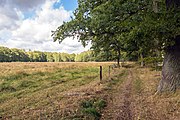 |
| Western Pomeranian Lagoons National Park | 1990 | 805 | |  |

Culture [edit]
Over the centuries, Mecklenburg and Vorpommern have developed and maintained strong regional cultures. It can generally be described as N German and has similar linguistic and historic characteristics to other north German language states, such as Schleswig-Holstein. People in Vorpommern, equally a outcome of that territory existence a sometime province of Prussia, tend to expect slightly more towards Berlin and Brandenburg than people in Mecklenburg would.
Compages [edit]
The cities are characterised past a certain "Hanseatic" style also found in other parts of northern Federal republic of germany (e.g. Lübeck) as well as in countries bordering the Baltic Sea like Republic of estonia (e.thousand. Tallinn) or Latvia (due east.1000. Riga). A common characteristic of many towns in Mecklenburg and Vorpommern are red Brick Gothic churches and houses dating back to the Middle Ages. Too stepped and tailed gables are a typical feature of the Hanseatic old towns, such as Stralsund, Wismar and Greifswald.
The old towns are usually built around one or several market places with a church or the boondocks hall. Oftentimes towns were founded at the Baltic Sea, one of the many lakes or a river for logistical and trade motives.
Rural areas of Mecklenburg-Vorpommern are often characterized by Brick Gothic village churches and agronomical heritage, like brick homesteads, thatched roof houses, windmills, manor houses and castles.

The central market square of Greifswald (Marktplatz), showing typical architecture of Mecklenburg-Vorpommern
Museums, art and theatres [edit]


The largest publicly funded theatres in the state are the Mecklenburg State Theatre, the Rostock People'south Theatre, the Theatre of W Pomerania, with venues in Stralsund, Putbus and Greifswald, and the Mecklenburg State Theatre of Neustrelitz with venues in Neubrandenburg and Neustrelitz. All four theatres offering both drama and musical theatre besides every bit orchestral music. Other important theatres are the Ernst Barlach Theatre of Güstrow, the Theatre of Parchim, the Anklam Theatre and the Wismar Theatre. In that location are also many small theatres on the Baltic coast and in individual artist'south villages and resorts (e.g. the popular concert pavilions at the Baltic Sea). Since its growing importance for summer tourism, open-air theatres and festivals go more common again also, such every bit the Störtebeker Festival on the island of Rügen, and the Vineta Festival on Usedom.
| Theatre | Visitors 2007/2008[fifteen] |
|---|---|
| Mecklenburg Country Theatre, Schwerin | 170,681 |
| Due west Pomeranian Theatre and Symphony Orchestra, Greifswald/Stralsund | 140,902 |
| Neustrelitz/Neubrandenburg Theatre and Orchestre | 120,042 |
| Rostock People's Theatre | 119,758 |
| West Pomeranian State Theatre, Anklam | 71,825 |
| Mecklenburg State Theatre, Parchim | fourteen,773 |
Since 1993, the Störtebeker Festival has taken place in Ralswiek on the island of Rügen. It is Germany's most successful open up-air theatre.
Notable museums include, for example, the Schwerin State Museum and the Pomeranian Country Museum at Greifswald. The German Oceanographic Museum with its Ozeaneum in Stralsund is the well-nigh pop museum in northern Frg. Furthermore, the German language Amber Museum in Ribnitz-Damgarten, Rostock'southward Abbey of the Holy Cross and Rostock Art Gallery are of national importance. The oldest museum in Mecklenburg-Western Pomerania is Stralsund's Cultural History Museum, the smallest is the Professor Wandschneider Sculpture Museum in Plau am Come across.
Mecklenburg-Vorpommern is home to many cultural events throughout the year. During summer, many open-air concerts and operas are open to visitors. The Mecklenburg-Vorpommern Festival (Festspiele Mecklenburg-Vorpommern) attracts a sizeable audition by performing classical concerts in parks, churches and castles.
Caspar David Friedrich, a famous romanticist painter born in Greifswald, immortalised parts of the state in several of his paintings.
Language [edit]

Today the vast majority of people speak Standard German; a few centuries ago most people spoke Depression German (German: Plattdeutsch or Niederdeutsch), a language that is still kept live within various communities and cultural events.
Food and drinks [edit]
Like most German regions, Mecklenburg and Vorpommern have their own traditional dishes, often including fish, beef and pork. Rostock has its own type of bratwurst chosen Rostocker Bratwurst. A famous dish from Western Pomerania is Bismarck Herring. Rote Grütze is a pop dessert. The largest beer breweries are Mecklenburgische Brauerei Lübz (Lübzer Pils), Hanseatische Brauerei Rostock, Darguner Brauerei and Störtebeker Braumanufaktur (Stralsund, multiple winner of the Globe Beer Cup). Likewise, at that place are many smaller breweries and craft beer variations, such equally the Mellenthin Castle Beer from Usedom Island.
Faith [edit]
As of 2020, the majority (82.4%) of the citizens of Mecklenburg-Western Pomerania are not religious or adhere to other religions. xiv.2% are members of the Evangelical Church in Germany and 3.4% of the Cosmic Church.[xvi]
Following the Reformation, led in Federal republic of germany by Martin Luther, as well equally a menses of Swedish rule, the traditional faith in Mecklenburg-Vorpommern is Protestantism, specifically Lutheranism. At that place are also a number of Catholics and people of other faiths.
In May 2012 the Evangelical Lutheran Church building of Mecklenburg merged with North Elbian Evangelical Lutheran Church and Pomeranian Evangelical Church into the new Evangelical Lutheran Church in Northern Germany.[17] Some parishes of the state belong to Evangelical Church of Berlin and Brandenburg.
There are as well Jewish communities, in the state capital of Schwerin (including Wismar) and in the city of Rostock. Historically, there were also synagogues in smaller towns, of which some are even so preserved (similar Röbel, Krakow am Come across and Boizenburg). The state's Jewish organisation is part of the Primal Quango of Jews in Frg.
Immigration [edit]
Largest immigrant communities[ citation needed ]:
 Syria Syria | 12,695 |
 Poland Poland | 10,789 |
 Ukraine Ukraine | four,190 |
 Russia Russia | 3,905 |
 Transitional islamic state of afghanistan Transitional islamic state of afghanistan | 2,700 |
 Romania Romania | 2,670 |
 Vietnam Vietnam | ane,945 |
 Bulgaria Bulgaria | 1,505 |
 Republic of hungary Republic of hungary | 1,290 |
 Turkey Turkey | i,285 |
 Lithuania Lithuania | 1,235 |
 Italy Italy | 1,100 |
 Greece Greece | 1,075 |
 Armenia Armenia | i,055 |
 Ghana Ghana | 1,050 |
Vital statistics [edit]
Education [edit]
Universities and colleges [edit]

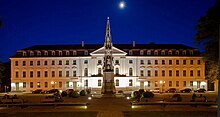
Mecklenburg-Vorpommern has the two oldest universities of the Baltic Sea region, also among the oldest of Germany and all of Europe:
- University of Greifswald (established 1456)
- University of Rostock (established 1419)
Likewise, in that location are further colleges / technological universities:
- Fachhochschule des Mittelstands (FHM)[xix] in Rostock and Schwerin (private)
- Rostock Academy of Music and Theatre
- Hochschule Wismar (Academy of Applied Sciences: Engineering, Business and Design)
- Fachhochschule Stralsund[20] (University of Applied Sciences)
- Hochschule Neubrandenburg[21] (University of Applied Sciences)
- Fachhochschule für öffentliche Verwaltung, Rechtspflege und Polizei Güstrow[22] (University of Administration, Judicature and Constabulary in Güstrow)
- Hochschule der Bundesagentur für Arbeit with its Schwerin campus
- DesignSchule Schwerin with options to study design (private; game/style/media/web design)
Schools [edit]
The state's school system is centralised. There are two master types of schools, Regionalschule (for the bulk of pupils) and Gymnasium (for the top 30% of each year's students, leading to the university entrance qualification "Abitur"). Likewise, there are also independent schools, comprehensive schools and trade schools.
Politics [edit]
Article 20 of the State Constitution states that the Landtag is the "site of political controlling".[23] The Mecklenburg-Vorpommern Landtag is elected democratically by the citizens of the state and sits for a 5-year legislative period.[23] The seat of the Landtag is located at Schwerin Palace in Schwerin.[23] The essential functions of the Landtag are to elect the Government minister-President of the state; to hash out and decide on laws which have been proposed by the regime, by any four members of the Landtag, or a people's initiative or petition for a plebiscite initiated direct by the people; and to control the state government.[23]
Minister-President [edit]

The executive is led by a chiffonier, in turn led past a Minister-President, who is the official head of land and government. The election to make up one's mind the Minister-President is held no later than four weeks after the newly elected Landtag is convened.[23]
Landtag [edit]

The last election of the Landtag of Mecklenburg-Vorpommern took place on 26 September 2021. The SPD won a landslide plurality of almost 40% of votes, a 9 percentage point increase from 2016. The opposition Alternative for Federal republic of germany (AfD) remained the 2d largest party but declined to nether 17%. The CDU recorded its worst ever result in the state with 13.3%, while The Left besides declined to x%. Alliance 90/The Greens and the Free Democratic Party (FDP) both won around vi% of votes and re-entered the Landtag after previously falling out in 2016 and 2011, respectively.[24]
The Landtag has been led past Minister President Manuela Schwesig since 2017. On thirteen October 2021, Schwesig appear the SPD would enter coalition talks with The Left. She stated her motivations for reorienting the coalition as a desire for "a new departure", and described The Left equally a "social, businesslike political party" with decisive policy overlap with the SPD. She said that The Left had been a reliable partner to the regime even while in opposition, and had assumed "country-political responsibility" during the COVID-19 pandemic.[25]
On 5 November 2021, the SPD and The Left agreed to a coalition government and programme to form a chiffonier, which is to be approved by each party-congress by mid-November.[26]
 | ||||||||||||
|---|---|---|---|---|---|---|---|---|---|---|---|---|
| Party | Constituency | Party list | Total seats | +/– | ||||||||
| Votes | % | +/– | Seats | Votes | % | +/– | Seats | |||||
| Social Democratic Party (SPD) | 313,224 | 34.41 | +iv.99 | 34 | 361,769 | 39.59 | +nine.03 | 0 | 34 | +8 | ||
| Culling for Germany (AfD) | 163,962 | 18.01 | –3.88 | 1 | 152,775 | 16.72 | –iv.ten | 13 | xiv | –4 | ||
| Christian Democratic Spousal relationship (CDU) | 157,403 | 17.29 | –4.50 | i | 121,583 | 13.30 | –5.68 | 11 | 12 | –iv | ||
| The Left (Die LINKE) | 106,189 | eleven.67 | –3.xx | 0 | ninety,881 | ix.94 | –3.23 | 9 | nine | –2 | ||
| Alliance 90/The Greens (GRÜNE) | 59,544 | 6.54 | +1.73 | 0 | 57,554 | vi.thirty | +1.48 | 5 | 5 | +5 | ||
| Complimentary Democratic Party (FDP) | 56,951 | half dozen.26 | +2.91 | 0 | 52,963 | 5.80 | +2.75 | 5 | v | +5 | ||
| Human Environment Brute Protection | half dozen,902 | 0.76 | +0.76 | 0 | xv,212 | 1.66 | +0.46 | 0 | 0 | ±0 | ||
| Grassroots Democratic Political party | sixteen,319 | 1.79 | New | 0 | 15,221 | 1.67 | New | 0 | 0 | New | ||
| Complimentary Voters | 18,324 | 2.01 | +0.95 | 0 | 10,075 | 1.10 | +0.51 | 0 | 0 | ±0 | ||
| National Autonomous Political party | 0 | 0.00 | – | 0 | 7,063 | 0.77 | –2.24 | 0 | 0 | ±0 | ||
| Die PARTEI | 1,826 | 0.20 | –0.11 | 0 | 7,023 | 0.77 | +0.14 | 0 | 0 | ±0 | ||
| Animal Protection Here! | 0 | 0.00 | New | 0 | 3,883 | 0.42 | New | 0 | 0 | New | ||
| Pirate Political party Germany | 1,774 | 0.nineteen | +0.15 | 0 | three,706 | 0.41 | –0.08 | 0 | 0 | ±0 | ||
| Free Horizon | 2,491 | 0.27 | –0.45 | 0 | three,348 | 0.37 | –0.45 | 0 | 0 | ±0 | ||
| Independents for Citizen-oriented Democracy | 558 | 0.06 | New | 0 | ii,331 | 0.26 | New | 0 | 0 | New | ||
| Political party for Health Inquiry | 0 | 0.00 | New | 0 | 2,030 | 0.22 | New | 0 | 0 | New | ||
| Team Todenhöfer | 0 | 0.00 | New | 0 | i,631 | 0.xviii | New | 0 | 0 | New | ||
| The Humanists | 0 | 0.00 | New | 0 | ane,105 | 0.12 | New | 0 | 0 | New | ||
| Ecological Democratic Political party | 0 | 0.00 | New | 0 | 936 | 0.10 | New | 0 | 0 | New | ||
| Alliance C – Christians for Germany | 186 | 0.02 | –0.02 | 0 | 827 | 0.09 | –0.01 | 0 | 0 | ±0 | ||
| German Communist Party | 0 | 0.00 | – | 0 | 727 | 0.08 | –0.08 | 0 | 0 | ±0 | ||
| Democracy in Motion | 0 | 0.00 | New | 0 | 563 | 0.06 | New | 0 | 0 | New | ||
| Free Parliamentary Brotherhood | 708 | 0.08 | New | 0 | 436 | 0.05 | New | 0 | 0 | New | ||
| Liberal Conservative Reformers | 0 | 0.00 | – | 0 | 221 | 0.02 | –0.28 | 0 | 0 | ±0 | ||
| Independents | 3,808 | 0.42 | –0.28 | 0 | 0 | 0.00 | – | 0 | 0 | ±0 | ||
| Full | 910,169 | 100.00 | – | 36 | 913,863 | 100.00 | – | 43 | 79 | – | ||
| Valid votes | 910,169 | 97.99 | +0.24 | 913,863 | 98.39 | +0.24 | ||||||
| Invalid/blank votes | eighteen,638 | 2.01 | –0.24 | 14,944 | 1.61 | –0.24 | ||||||
| Total votes | 928,807 | 100.00 | – | 928,807 | 100.00 | – | ||||||
| Registered voters/turnout | 1,312,471 | seventy.77 | +8.92 | 1,312,471 | 70.77 | +8.92 | ||||||
| Source: State Returning Officer | ||||||||||||
Economic system [edit]
The gdp (Gross domestic product) of the land was 44.v billion euros in 2018, accounting for 1.3% of German economic output. GDP per capita adjusted for purchasing ability was 25,400 euros or 84% of the EU27 boilerplate in the same twelvemonth. The GDP per employee was 83% of the EU average. The GDP per capita was the lowest of all German states.[27]
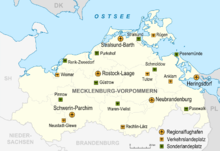
Airports in Mecklenburg-Western Pomerania
Labour market [edit]
Mecklenburg-Vorpommern is the least densely populated and least industrial German land, being the sixth largest in area, merely simply the 14th in population. Formerly, unemployment has been negatively affected by the breakdown of not-competitive old GDR industries after the German reunification in the 1990s. Every bit of 2018 unemployment is the everyman in more than than 15 years while the economic system is growing and the number of jobs is increasing continually. Growing sectors are biotechnology, data engineering science, life sciences, maritime industry and tourist services.
In Mecklenburg-Vorpommern, approximately 732,200 people were gainfully employed in 2008 with 657,100 of them were white and bluish collar workers. About 4,200 new jobs were created in 2007. Employees worked an average of 1,455 hours a year. The number of cocky-employed did not change in 2008. 3 out of every four of all workers are employed in the service sector.[28] In October 2018 the unemployment rate stood at seven.i% and was the tertiary highest rate in Germany.[29]
| Year[xxx] | 2000 | 2001 | 2002 | 2003 | 2004 | 2005 | 2006 | 2007 | 2008 | 2009 | 2010 | 2011 | 2012 | 2013 | 2014 | 2015 | 2016 | 2017 | 2018 |
|---|---|---|---|---|---|---|---|---|---|---|---|---|---|---|---|---|---|---|---|
| Unemployment rate in % | 17.8 | 18.iii | 18.6 | 20.one | xx.iv | 20.three | xix.0 | 16.5 | 14.1 | 13.5 | 12.seven | 12.5 | 12.0 | 11.vii | 11.2 | ten.four | nine.seven | 8.six | vii.9 |
Tourism [edit]
Mecklenburg-Vorpommern is the acme destination for intra-German tourism and is gaining importance for international tourism. The chief tourist regions are:
- Islands: Rugia and Usedom (Germany's two largest islands), Poel and Hiddensee;
- Peninsula: Fischland-Darß-Zingst (with Ahrenshoop and Zingst);
- Seaside resorts: Binz, Boltenhagen, Graal-Müritz, Heringsdorf (including Bansin and Ahlbeck), Heiligendamm, Kühlungsborn, Warnemünde and Zinnowitz;
- Stettin Lagoon: Ueckermünde;
- Hinterland: particularly the Mecklenburg Lakeland; and
- Cities: Stralsund and Wismar (both listed as UNESCO World Heritage Sites), Schwerin, Güstrow, Rostock and Greifswald, which have a diverse cultural heritage.
- Nighttime heaven: Mecklenburg-Vorpommern is home to some of the most pristine dark skies in Germany, especially in the surface area near Nationalpark Müritz. It is a potential site for a Night Sky Park.
Equally a reminder of its rich history, almost two,000 castles, palaces and manor houses exist in Mecklenburg-Vorpommern, many of which are used as venues for public events like concerts and festivals, such as Festpiele MV[31] (a classical music festival).
Medical tourism[14] based on the make clean air and idyllic settings by the Baltic Sea has a growing importance to the regional tourism industry.[14]
-

-

Moonrise over Nationalpark Müritz
-

V2 rocket replica in Peenemünde. These rockets were the first man-made objects to reach space.
Sport [edit]
Master sporting attractions include the High german football league games of F.C. Hansa Rostock and the international sailing outcome Hanse Sail. If the bid for the 2012 summer Olympics in Leipzig had been successful, the sailing competitions would have taken identify off the coast of Rostock.[32]
Notable people [edit]

Notable from Mecklenburg-Vorpommern include:
- Arts: Ernst Barlach, Friedrich von Flotow, Caspar David Friedrich, Marianne Hoppe, Till Lindemann, Philipp Otto Runge
- Business: Ernst Heinkel, Carl Heinrich von Siemens, Leonhard Tietz, Georg Wertheim
- Literature: Ernst Moritz Arndt, John Brinckman, Hans Fallada, Walter Kempowski, Fritz Reuter, Rudolf Tarnow, Ehm Welk
- Politics: Ernst Moritz Arndt, Dietmar Bartsch, Joachim Gauck, Egon Krenz, Gebhard Leberecht von Blücher, Angela Merkel, Helmuth von Moltke the Elderberry, Harald Ringstorff
- Science: Theodor Billroth, Friedrich Chrysander, Walther Flemming, Gottlob Frege, Otto Lilienthal, Gustav Mie, Ferdinand von Mueller, Paul Pogge, Carl Wilhelm Scheele, Heinrich Schliemann, Johannes Stark
- Sports: Tim Borowski, Andreas Dittmer, Thomas Doll, Carsten Jancker, Marita Koch, Toni Kroos, Sebastian Sylvester, Jan Ullrich, Jens Voigt
Miscellaneous [edit]
- Mecklenburg-Vorpommern is Germany's number-one tourist location, the main destinations existence the Baltic Sea coastline with islands such equally Rügen or Usedom, spa towns like Heiligendamm, Kühlungsborn, Boltenhagen or Warnemünde and the Mecklenburg Lake District. It also offers important historical cities, such every bit Stralsund, Wismar, Greifswald and Rostock as erstwhile Hanseatic cities − or Schwerin, Güstrow, Ludwigslust and Neustrelitz equally onetime residences.
- The get-go rockets to reach outer space were launched in 1944 during World War II in Peenemünde on the present-day territory of Mecklenburg-Vorpommern.[33]
- During the chancellorship of Angela Merkel, Mecklenburg-Vorpommern hosted the first official public meeting with President George West. Bush in 2006 and the 33rd G8 summit in 2007. Both political events were financed by country and federal budgets.
Gallery [edit]
-

-

-

Schwerin − capital of Mecklenburg-Vorpommern
-
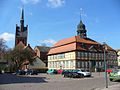
Grabow − One-half timbered town hall
-

-
-

-

Run into also [edit]
- History of Pomerania
- List of places in Mecklenburg-Vorpommern
- Listing of towns in Vorpommern
- Mecklenburg
- Pomerania
References [edit]
- ^ "Bevölkerungsstand der Kreise, Ämter und Gemeinden in Mecklenburg-Vorpommern". Landesamt für innere Verwaltung Mecklenburg-Vorpommern (in High german). 3 July 2019. Retrieved 23 May 2020.
- ^ "Bruttoinlandsprodukt – in jeweiligen Preisen – 1991 bis 2019". statistik-bw.de.
- ^ With the abolition of states in East Germany in 1952 vehicle registration followed the new Bezirk subdivisions. Since 1991, distinct prefixes are specified for each commune.
- ^ "Sub-national HDI - Surface area Database - Global Information Lab". hdi.globaldatalab.org . Retrieved 13 September 2018.
- ^ Krech, Eva Maria; Stock, Eberhard; Hirschfeld, Ursula; Anders, Lutz-Christian (2009), Deutsches Aussprachewörterbuch, Berlin, New York: Walter de Gruyter, p. 733, ISBN978-3-11-018202-6
- ^ Dudenredaktion; Kleiner, Stefan; Knöbl, Ralf (2015) [Get-go published 1962], Das Aussprachewörterbuch (in German language) (seventh ed.), Berlin: Dudenverlag, p. 590, ISBN978-three-411-04067-4 . Co-ordinate to this source, the pronunciation with [eː] is mainly found in Northern Germany (so Mecklenburg-Vorpommern itself as well). It is the historical pronunciation. In other regions, the spelling pronunciation with [ɛ] is usual.
- ^ Steinhauer, Anja (2014). Duden – Das Wörterbuch der Abkürzungen. Mannheim: Dudenverlag. p. 287. ISBN978-iii-411-90269-nine.
- ^ Gesellschaft für Deutsche Sprache (1990), Der Sprachdienst (in German), vol. 34, Wiesbaden, p. 128
- ^ Der Proper name Pommern (po more) ist slawischer Herkunft und bedeutet then viel wie "Land am Meer". Pommersches Landesmuseum
- ^ Michael North, Geschichte Mecklenburg-Vorpommerns (2008), p. 113
- ^ a b Michael North, The Baltic: A History (2015), pp. 187–189
- ^ Brunner, Detlev, Inventar der Befehle der Sowjetischen Militäradministration Mecklenburg (-Vorpommern) 1945−1949 in Texte und Materialien zur Zeitgeschichte 12, 2003, ISBN 3-598-11621-vii
- ^ Beatrice Vierneisel, Fremde im State: Aspekte zur kulturellen Integration von Umsiedlern in Mecklenburg und Vorpommern 1945 bis 1953, 2006, p.12, ISBN three-8309-1762-7, ISBN 978-3-8309-1762-5
- ^ a b c "Branche mit Zukunft". Die Welt (in German). vii May 2009. Retrieved 8 May 2009.
- ^ "(PDF) Visitor nos. at public theatres in M-5" (PDF). Archived (PDF) from the original on sixteen October 2013.
- ^ Evangelische Kirche in Deutschland – Kirchemitgliederzahlen Stand 31. Dezember 2020 EKD, Nov 2021
- ^ "Nordkirche - nordkirche.de". www.nordkirche.de. Archived from the original on 12 May 2014.
- ^ "Bevölkerung". Statistische Ämter des Bundes Und der Länder . Retrieved 16 June 2018.
- ^ "University of Applied Sciences: fh-mittelstand.de". Archived from the original on 15 August 2015. Retrieved 27 July 2015.
- ^ "Fachhochschule Stralsund - University of Engineering science". Archived from the original on 4 March 2015.
- ^ "University NB: Hochschule Neubrandenburg". Archived from the original on 8 October 2012.
- ^ "FH Güstrow". Archived from the original on 10 October 2012.
- ^ a b c d e "Country Parliament". Mecklenburg-Vorpommern. Archived from the original on ii April 2011. Retrieved xxx March 2011.
- ^ "State election MV: Schwesig's SPD triumphs - CDU experiences debacle". Norddeutscher Rundfunk (in High german). 27 September 2021.
- ^ "Mecklenburg-Vorpommern: Schwesig wants to govern with the Left Party". tagesschau.de (in German). Tagesschau. 13 October 2021. Retrieved 14 October 2021.
- ^ "SPD and Left agree on coalition understanding". tagesschau.de (in High german). Tagesschau. 13 October 2021. Retrieved 7 Nov 2021.
- ^ "Regional Gross domestic product per capita ranged from 30% to 263% of the European union average in 2018". Eurostat. Archived from the original on ix October 2022.
- ^ "Employment and Labour Market". Mecklenburg-Vorpommern. Archived from the original on vii March 2011. Retrieved 30 March 2011.
- ^ "Arbeitslosenquote nach Bundesländern in Deutschland 2018 | Statista". Statista (in German language). Retrieved 13 November 2018.
- ^ (Destatis), © Statistisches Bundesamt (xiii Nov 2018). "Federal Statistical Role Frg - GENESIS-Online". www-genesis.destatis.de . Retrieved 13 November 2018.
- ^ "Festspiele Mecklenburg-Vorpommern". Archived from the original on 19 October 2012.
- ^ "Deutsche Olympia-Bewerber - Leipzig und Rostock". northward-tv.de (in German language). 12 April 2003. Retrieved 19 May 2020.
- ^ Dyson, Marianne J. (2007). Space and astronomy: decade by decade. Infobase Publishing. p. 95. ISBN978-0-8160-5536-4.
External links [edit]
- Official Mecklenburg-Vorpommern portal
-
 Geographic information related to Mecklenburg-Vorpommern at OpenStreetMap
- Tourism
- Off to MV - Official tourism website of Mecklenburg-Vorpommern
- Deutschland.Travel - Federal Tourism Association: Mecklenburg-Vorpommern
Source: https://en.wikipedia.org/wiki/Mecklenburg-Vorpommern
0 Response to "Wie Heißt Die Hauptstadt Von Mecklenburg Vorpommern"
Post a Comment